
A market order is executed at the best price currently available in the order book (Market Depth), not at the LTP you see on the screen. Since market orders prioritise execution speed over price, they may get filled at prices that differ from the Last Traded Price (LTP) — especially when the market is moving fast.
Example: In the image below, the LTP is ₹1,12,571. If you place a Buy market order, it may execute at ₹1,12,632, because that is the best price sellers are offering at that moment.
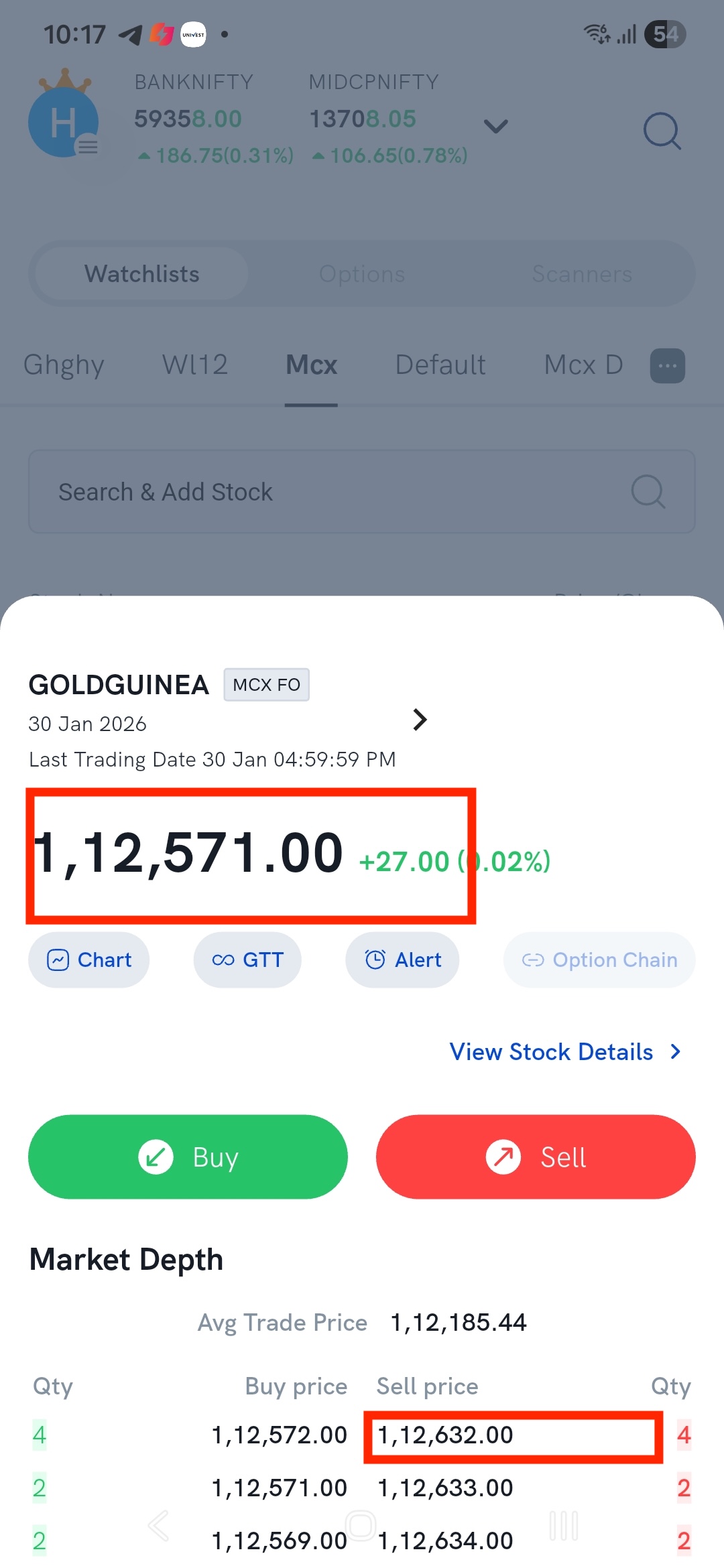
In high-value trades or low-liquidity situations, a market order can consume multiple price levels in the order book, resulting in a much higher execution price (for a Buy) or lower (for a Sell) than the displayed LTP. This difference is called slippage, and it grows with volatility, large order size, or thin market depth.
What is Market Price Protection (MPP)?
Market Price Protection (MPP) adds a price safety limit to your market order. When enabled, Rupeezy calculates a dynamic protection price range based on the live LTP and instrument type. Your order still executes instantly, but only at the best available price within this protected range.
If the full quantity cannot be filled within the range, the unfilled quantity stays pending as a limit order at the protection price, instead of executing at an unfavourable price outside your risk limit.
How does MPP help you?
- Prevents unexpected losses from high slippage
- Keeps execution within a safe price boundary
- Still fills at the best available price first
- Converts any unfilled quantity into a limit order instead of a risky market fill
When should you enable MPP?
- The market is moving fast
- Liquidity is low
- You are placing large orders
- You want instant execution without price risk beyond a limit
How does it work?
On the order screen, select Market Order and turn on the MPP toggle — you can enable or disable it any time.
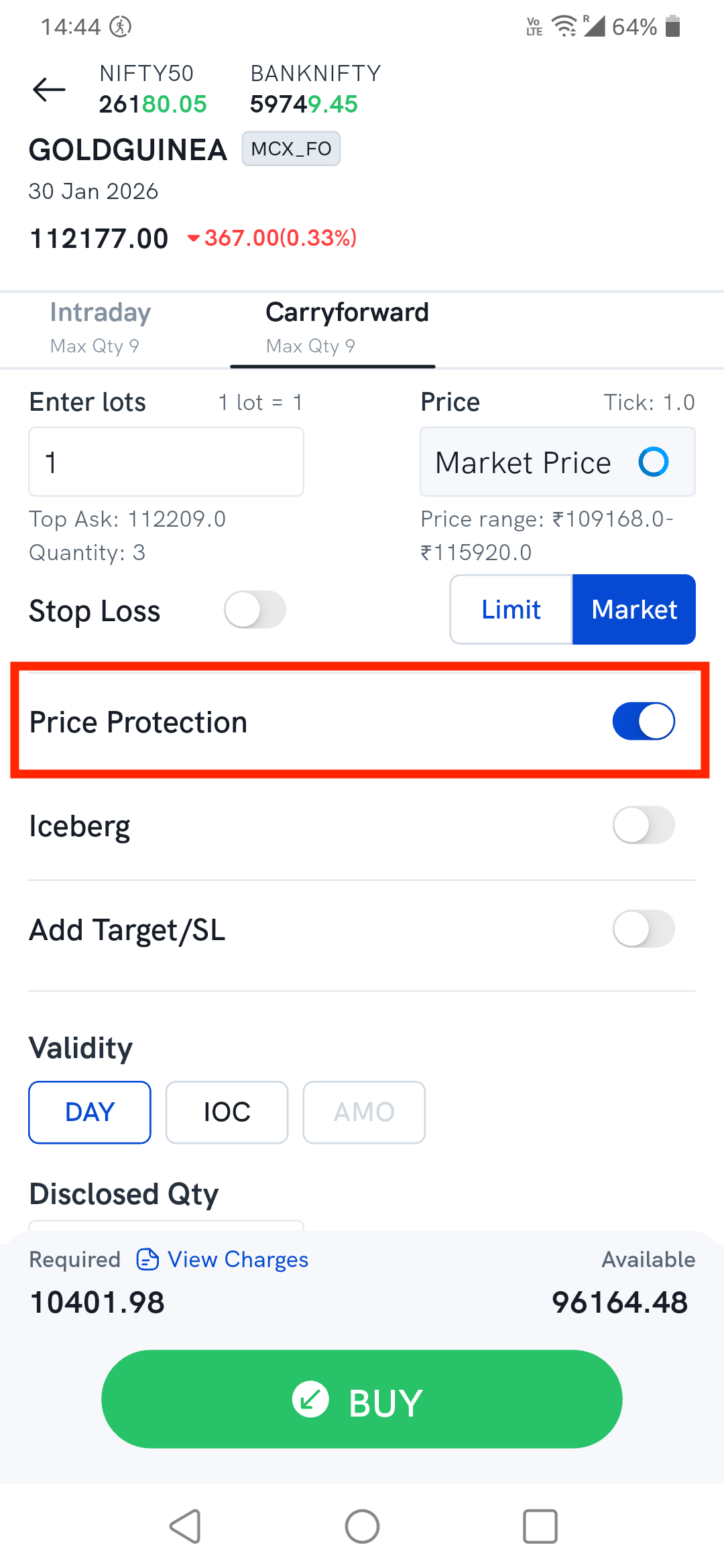
- Rupeezy calculates a dynamic protection price from the table below.
- Your order is sent to the exchange as a limit order at the protection price (LTP ± %).
- The exchange fills it at the best available price first, as long as that price is within the protected limit. For example, if the protection price is ₹91 for a Buy order and market depth shows an Ask at ₹90 for 5 quantity, the order executes at ₹90 — better than the limit.
- If the price moves beyond the protected range before the order is fully filled, the remaining quantity stays pending as a limit order instead of executing at a worse price.
Protection range table
| Security type | LTP range | Protection % |
|---|---|---|
| Equity & Futures | Below ₹100 | 2% |
| Equity & Futures | ₹100 – ₹500 | 1% |
| Equity & Futures | Above ₹500 | 0.5% |
| Options | Below ₹10 | 5% |
| Options | ₹10 – ₹100 | 3% |
| Options | ₹100 – ₹500 | 2% |
| Options | Above ₹500 | 1% |
Important notes
- MPP does not guarantee a 100% fill.
- It guarantees no fill beyond the protected price range.
- Any pending quantity stays active as a limit order, not a market order.
- The protection range updates dynamically based on instrument type and LTP.